Request access

LEASE-iQ · For leaseholders and building teams

Understand the lease. Put it to work.

Understand responsibilities, prevent avoidable problems and handle them fairly when they arise. LEASE-iQ connects the lease and relevant law, then drafts the guidance, policies, replies and lawyer briefs you need.

Connected clauses. Source checks. Unresolved points made clear.

Check one lease freeFree month for teams

One residential lease with no time limit, or up to 100 leases for your team’s first month. No card. Access confirmed before you upload.

Watch the worked exampleAlready have access? Sign in

Find an example for your role.

Choose your role to see the question, the work and the next step. Each film has English captions and a transcript. Use full screen to inspect the detail.

Leaseholders and buyersA leak in your flat. What happens next?

Leaseholders · 1:07

A leak in your flat. What happens next?

Five questions to try with your lease

  1. Water is coming into my flat. Who needs to act, and what should I do next?
  2. Can I rent out my flat, and what do I need to do?
  3. Can I alter my flat, and whose permission do I need?
  4. I do not understand this service charge. What does my lease say?
  5. I want to sell my flat. What do I need to arrange?
Read the transcript

Water is coming into your flat. You want it stopped, and you want to know who should act.

A leak can involve more than one repair obligation. This recorded LEASE-iQ example brings together the flat’s repair duties, shared pipes, access and insurance. It separates who repairs from who ultimately pays.

The useful outcome is an organised brief. It identifies what the lease says, the competing explanations and the evidence still needed. Here, that includes the plumbing reports, other flats’ leases and the insurance policy.

Look at the practical questions: does the pipe serve one flat or several? What investigation will identify the source? What urgent work is needed? The lease cannot diagnose the leak, but it helps organise the next conversation.

If responsibility remains disputed, the brief gives a property solicitor specific questions to resolve. You have a clearer next step, with the uncertainty visible.

Use your own lease. Start with the problem you are facing, then ask LEASE-iQ to help prepare what you need next.

Request your free lease

Managing agentsTurn a disputed leak into a focused brief

Managing agents · 1:10

Turn a disputed leak into a focused brief.

Five questions to try with your lease

  1. We have a disputed leak. What does the lease establish, and what do we need to investigate?
  2. A block wants to switch to us. Who can appoint us, and what needs checking?
  3. Extract the key lease terms we need to manage this building into a referenced summary.
  4. We need access for repairs. What does the lease require?
  5. A resident wants to make alterations. What information and permissions are needed?
Read the transcript

A resident reports a leak. One explanation points to a bathroom refurbishment. Another points to a communal waste stack. Everyone wants to know who is responsible.

This LEASE-iQ example turns that dispute into a structured brief. It brings together the repair clauses, access rights, insurance provisions and possible cost recovery, while keeping reported events separate from document evidence.

The output does something useful with the complexity. It sets out the possible positions of the affected leaseholder, the upstairs owner and the freeholder. It then identifies what would help resolve the disagreement.

The next actions are concrete: obtain the plumbing reports, check the other leases, inspect the insurance policy and establish the notice history. Where interpretation remains disputed, there are focused questions for the property solicitor.

The outcome is a shared starting point for the people who need to act. It does not pretend that a lease proves what caused a leak.

You can also ask LEASE-iQ for a management summary, an access checklist or the requirements for a consent application. Start with the job you need to get done.

Request your free team month

Housing associationsHelp a customer explore a way forward

Housing associations · 1:14

Help a customer explore a way forward.

Five questions to try with your lease

  1. A customer wants to run a business from a shed, enlarge it and add power. What needs checking?
  2. Can we find a lawful route for a proposed alteration, and what needs solicitor review?
  3. A customer disputes a repair responsibility. What does the lease establish?
  4. What costs does this lease allow us to recover, and what conditions apply?
  5. Draft a clear customer explanation of the answer and the next steps.
Read the transcript

A customer wants to run a business from a shed, enlarge it and connect power. For a housing association, that is one customer request with several connected decisions.

In this actual LEASE-iQ answer, the request is broken into business use, building work and electrical work. It finds a home-office qualification in one part of the lease and a separate business restriction elsewhere. It also identifies the importance of the plan, neighbouring rights and a separate transfer document.

The useful outcome is a specific list of information needed before responding. What kind of business? Will customers visit? Where will the larger shed stand? What electrical work is proposed? What does the insurer say?

That creates a better discussion with the customer and your property solicitor. They can assess whether any lawful route is available, including whether a variation is appropriate. This answer does not establish that a variation can be granted.

The aim is a considered way forward: explain the constraints, explore workable options and establish any reasonable costs before proceeding. Start with the customer’s problem. Let LEASE-iQ help organise the detail.

Request your free team month

Freeholders and resident directorsCan our block change managing agent?

Freeholders and resident directors · 1:13

Can our block change managing agent?

Five questions to try with your lease

  1. Can our block change managing agent? If we can, what do we need to do?
  2. What does the lease require before we arrange major works?
  3. Who is responsible for the roof, and how can the cost be recovered?
  4. What are our building insurance obligations?
  5. A resident wants permission for works. What must we consider?
Read the transcript

Can our block change managing agent? If we can, what do we need to do?

That simple question produces more than a yes or no. In this lease, LEASE-iQ identifies the landlord’s power to employ managing agents. It then separates that contractual position from possible routes for residents to take control.

The distinction matters. Changing a supplier when you already have authority is different from first obtaining that authority. The answer identifies information that the lease alone cannot confirm, including current freehold ownership and whether residents own shares in the freehold company.

The useful outcome is a decision checklist. Establish who can authorise the change. Check the company’s governance where relevant. Then review the existing management agreement for termination and handover requirements.

If a statutory route is needed, the building’s eligibility and the legal process need their own checks. LEASE-iQ gives you issues and sources to take forward, without treating missing facts as settled.

Next, ask for the key lease terms the incoming agent will need. Move from the question to an organised handover, with the responsible people involved.

Request your free team month

Estate agentsFind lease issues before they delay a sale

Estate agents · 1:11

Find lease issues before they delay a sale.

Five questions to try with your lease

  1. I want to sell this flat. What could hold up the sale, and what should we arrange?
  2. Does this sale need landlord consent?
  3. What notices and documents are needed after completion?
  4. What use restrictions should a prospective buyer know about?
  5. Turn the answer into a checklist for the estate agent and conveyancer.
Read the transcript

Your client wants to sell a flat. What needs sorting out before the sale progresses?

Ask LEASE-iQ the ordinary question, then ask it to turn the answer into a practical checklist for the estate agent and solicitor. That is what happened in this example.

The answer identifies conditions that are easy to miss. It checks marketing signs, the type of buyer, amounts due under the lease and the formal steps after completion. These are findings from this particular lease, not rules to assume for every flat.

The useful output separates the work. The estate agent gets a marketing and buyer-screening checklist. The solicitor gets initial checks, any consent application, pre-completion conditions and post-completion notices.

It also says what the lease cannot tell you: the current account balance, the current landlord’s details and the actual fees. Those need up-to-date evidence.

You can see the wording behind the answer and identify what needs attention early. The conveyancer still checks the title and advises on the transaction.

Start with the sale. Let LEASE-iQ help turn the lease into a practical list of things to resolve.

Request your free team month

Lettings agentsFrom “Can I let?” to the building rules

Lettings agents · 1:10

From “Can I let?” to the building rules.

Five questions to try with your lease

  1. Can I rent out this flat, and what do I need to do before a tenant moves in?
  2. Extract the building rules I should give the tenant.
  3. Can the tenant keep a pet, and is permission needed?
  4. Does the lease restrict who can occupy the flat or how it is let?
  5. What consents and notifications are needed, and how does current letting law affect this?
Read the transcript

A landlord asks: can I rent out my flat, and what do I need to do?

Start there. You do not need to supply LEASE-iQ with a list of legal issues. It examines the lease and identifies the conditions that matter to the proposed letting.

Then continue the job. In this example, the follow-up asks LEASE-iQ to extract the building rules for the tenant. The answer brings together restrictions on noise, pets, common parts and other matters across the lease.

That is a useful output you can check and turn into a tenant information pack. You can trace a rule back to the lease, identify where permission is needed and ask for the requirements in plain English.

Keep two questions separate: what this lease requires, and what current letting law requires for this tenancy. The rules extract does not, by itself, settle the tenancy’s legal position. Any unresolved point needs checking before the letting proceeds.

The outcome is practical: a clearer list of conditions and building rules, with the outstanding checks visible. Ask your question, inspect the evidence, then ask for the next piece of work.

Request your free team month

Property solicitorsSolar panels: from question to draft deed

Property solicitors · 1:16

Solar panels: from question to draft deed.

Five questions to try with your lease

  1. Can this leaseholder install solar panels, and what rights or consents would be needed?
  2. Identify the connected covenants, qualifications and exceptions for this proposal.
  3. What documents and title information are missing before we can advise?
  4. Prepare drafting instructions and flag the terms that still need agreement.
  5. Prepare a draft deed of variation for solicitor review, marking unresolved points.
Read the transcript

A leaseholder wants solar panels on the roof. Can they proceed, and what documentation might be needed?

In this actual LEASE-iQ conversation, a plain question leads to analysis of the retained roof, structural restrictions, cabling, insurance and access. The user then asks for a document to take to their solicitor, followed by a draft deed of variation.

The useful outcome is a substantive working draft. It addresses the solar equipment, roof zone, cable route, new rights, maintenance, weatherproofing and temporary removal for roof works.

Unagreed terms remain visible. The draft marks the plan, access arrangements, commercial terms and costs for agreement. Its accompanying checklist flags current parties and titles, lender consent, other flats’ rights and registration.

For the property solicitor, that is material to examine, amend and develop against the source documents and the client’s instructions. It is not an approved deed or permission to install the panels.

The value is in carrying the question forward into concrete work, while leaving legal judgement with the adviser. Start with the client’s objective. Ask LEASE-iQ to prepare the next draft for your review.

Request your free team month

Local authoritiesExplain the basis of a proposed charge

Local authority · 1:20 · Earlier worked example

Explain the basis of a proposed charge.

A public City of London specimen and a hypothetical estimate show what needs checking before explaining a resident’s share.

Read the transcript

A resident asks why their estimated share of window works is £18 ,000. They need an explanation of how the figure was reached. This example uses a public City of London specimen and a hypothetical estimate. We ask what contribution percentage the document specifies. LEASE-iQ takes us to the wording. We open the original PDF and see that the percentage is blank. This specimen cannot establish the terms of the resident's signed lease. There is a separate question about consultation. The source reference opens the legislation, including the qualification about dispensation. We read the relevant provision and check how it applies to the works and the facts. A citation is a route to checking the answer. We now have a clear request for colleagues. The signed lease, relevant later documents, the allocation calculation and the works and consultation records. A draft reply can acknowledge the resident's question and explain what still needs verifying. Read it from the resident's perspective. Have we explained their individual share or simply repeated a figure? A human confirms the case owner and the next update before the response is used. The outcome is a supported explanation or a precise list of what is missing. For a complex dispute, gather the checked sources, chronology and correspondence into a focused note for a property solicitor to review.

Request your free team month

Commercial propertyNewsteer: a difficult commercial lease scan

Commercial property · 0:46 · Earlier worked example

Newsteer: a difficult commercial lease scan.

A historical Scottish lease example showing document extraction and uncertainty. Current access and supported scope must be confirmed before uploading a commercial lease.

Read the transcript

This is the commercial lease we worked through with Newsteer, a Scottish lease from 1963. Look at the quality of that scan. Dense wording, marks across the page and information spread through the document. These are saved stills from that example. LEASE-iQ extracted information and provided references back to the lease. Where information was not stated in the documents provided, it said so. Here, the date readings conflicted. The output says, conflict needs check. It leaves the different readings and their references visible for a human to examine. That is an important part of the answer. Knowing what the document supports and what still needs checking. A focused question can then go to the appropriate adviser with the context already assembled.

Request commercial access

Examples use individual English leases. LEASE-iQ covers England and Wales. Answers depend on your document and circumstances. Check the sources and seek professional advice where needed. Films use edited answer excerpts; processing time is omitted.

Start with your own question.

Request your free team monthRequest your free lease

Built for the way leases work

A simple question. A structured process behind the answer.

A lease can put the definition on one page, the obligation on another and the exception in a schedule. LEASE-iQ is built to connect that wording with relevant legislation, then help you understand the answer and act on it.

How LEASE-iQ works

The question, connected lease wording, legislation and different checks.

Read the full transcript

Can I rent out my flat? Can our block change managing agent? Can I put solar panels on the roof?

Start with the problem. You should not have to identify every clause or know which legal questions to ask.

LEASE-iQ breaks the question into the decisions that need answering. It connects definitions, obligations, conditions and exceptions across the lease, then brings relevant legislation into the analysis.

Generative AI weighs possible interpretations. That is probabilistic. Fixed checks, such as testing quoted words against their source, are deterministic. These checks have different jobs. A matching quotation alone does not prove a correct legal interpretation.

Proposed answers are challenged, with additional review routes for complex questions and correspondence. This work takes time. Complex questions can take longer, and an answer may still need further checking.

Then continue the task. Ask for the building rules your tenant needs. Extract a management summary. Turn a sale answer into a checklist. Or prepare a draft for your property solicitor to review.

Open the sources. Check what is established, what is missing and what still needs agreement.

From a real question to a useful next step. LEASE-iQ. Try it with your own lease and inspect the evidence.

  1. 01

    Read the document

    Turn the PDF or scan into structured text, with the original page available to inspect.

  2. 02

    Connect the meaning

    Bring definitions, clauses, schedules and relevant legislation into the question.

  3. 03

    Challenge the answer

    The checking approach includes AI review and code that tests quoted wording against source text.

  4. 04

    Show you the evidence

    Open the lease and law, see what remains uncertain, then draft and refine your next step.

Robust checks. Practical verification. No AI or lawyer can promise 100% accuracy. Match your own checking to what is at stake: a clear pet clause may need a quick look at the conditions; a disputed bill or major works deserves a closer check.

How LEASE-iQ works, in plain English

See how the checking route varies with the question.

The simple how-to · 1:01

Start with one lease and one question.

Once your access is confirmed, upload the lease and ask your question in ordinary language. You can start with a summary if it helps.

Choose your lease, ask your question and inspect the sources.

Sign in to LEASE-iQ · Request access · Watch how the method works

Read the full transcript

Start with a lease and a question that matters to you. Sign in to LEASE-iQ, then upload a readable PDF. You can add tags to help organise your documents. Allow time for processing.

Choose your lease and check its status. If it is marked out of date, resolve that before relying on a new answer. You have a choice: start with a summary, or open an empty chat and ask your own question. A summary takes time to prepare.

Ask in ordinary language. Who repairs this window? Who pays? What permission do I need? LEASE-iQ reads the lease and checks its answer. This is not instant, and the screen shows its progress.

Read the explanation, then inspect the supporting lease wording and legislation. Check the conditions, exceptions and missing facts. Use a follow-up question to clarify what remains uncertain.

Bring a question you know, inspect the evidence, then try the difficult one. Information to support your judgement, with professional advice where needed.

Put it to work

Start with your lease and a real question.

Your home

For leaseholders and buyers. Understand your responsibilities, what needs permission and what to do next.

Check one lease free

One residential lease. No time limit.

Your building or team

For managing agents, housing associations, resident directors and property teams. Turn the lease into guidance, policies and replies.

Request your free team month

Up to 100 leases for one month. Setup and weekly reviews included.

No card or automatic paid plan. Access and the secure upload route are confirmed first; team users and month dates are agreed before you start. Offer details and pricing.

Watch the one-minute getting-started film · Already have access? Sign in

More detail: source checks, questions, solicitor briefs and what’s next.

See the answer and its sources together.

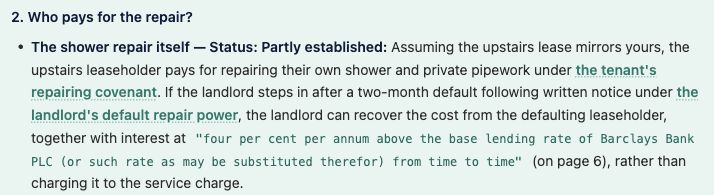
“There’s a leak in my flat. Who investigates, and who pays?”

  1. 01 · MA investigatesIt’s the upstairs shower

    The landlord’s plumber identifies the source.

  2. 02 · Shower repairUpstairs owner repairs and pays*

    *If their lease has the repairing obligation shown below. Confirm their lease first.

  3. 03 · Investigation: upfrontLandlord pays the plumber

    The MA arranges payment for the landlord, potentially using existing service-charge funds.

  4. 04 · Passing the cost onOnly if the lease and law allow

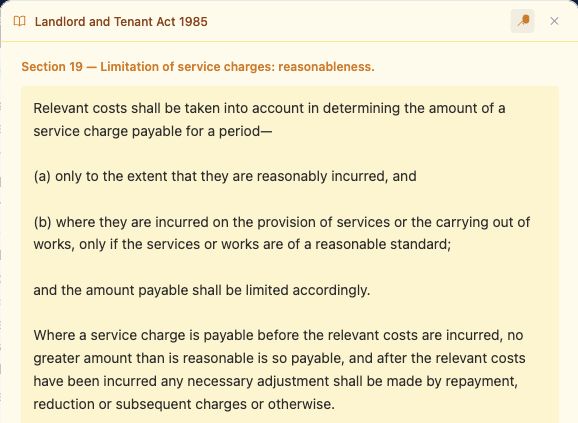
    Through service charges: the lease must cover it and the cost must be reasonable. Billing the upstairs owner alone needs separate grounds.

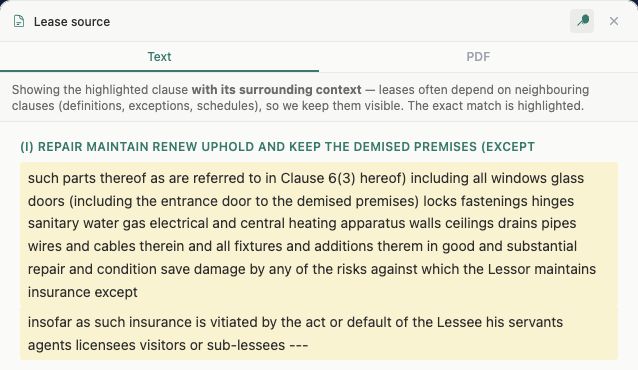
Illustrative scenario. Real LEASE-iQ answer and source views shown together. Select a view to enlarge.
What does LEASE-iQ establish?

This is an illustrative follow-through: the managing agent arranges an investigation for the landlord, and the plumber identifies the upstairs shower as the source. The finding is supplied to LEASE-iQ; it does not diagnose the leak.

The repair: LEASE-iQ checks the repairing covenant and its exceptions. The upstairs owner’s own lease must establish their responsibility for the shower; another flat’s lease is not enough.

The investigation: the landlord pays the contractor it appointed, directly or through its agent. The initial investigation may be recoverable through service charges if it was properly undertaken for the landlord’s obligations, the lease covers it and the cost is reasonably incurred. That is not automatic just because the MA arranged it. Charging that cost to the upstairs owner alone needs a separate basis in their lease or other legal grounds, with the relevant evidence and legal checks. Finding the leak in their flat does not automatically make the whole bill theirs.

Insurance and damage to the affected flat need separate checks. Your lease and circumstances may lead to a different answer.

Trust and verify. In proportion to the decision.

LEASE-iQ is built around accuracy: connected lease wording, relevant legislation, checks on the answer and original sources you can inspect. No AI or lawyer can promise 100% accuracy.

A clear pet clause may need a quick look at the permission conditions. For money, major works or a dispute, open the lease and legislation and personally check the detail. Ask LEASE-iQ to draft and refine the response, then take the next step.

See how LEASE-iQ works → · Want specialist advice? Prepare the brief here →

The old way and the LEASE-iQ way

From searching the lease to opening the source behind the answer.

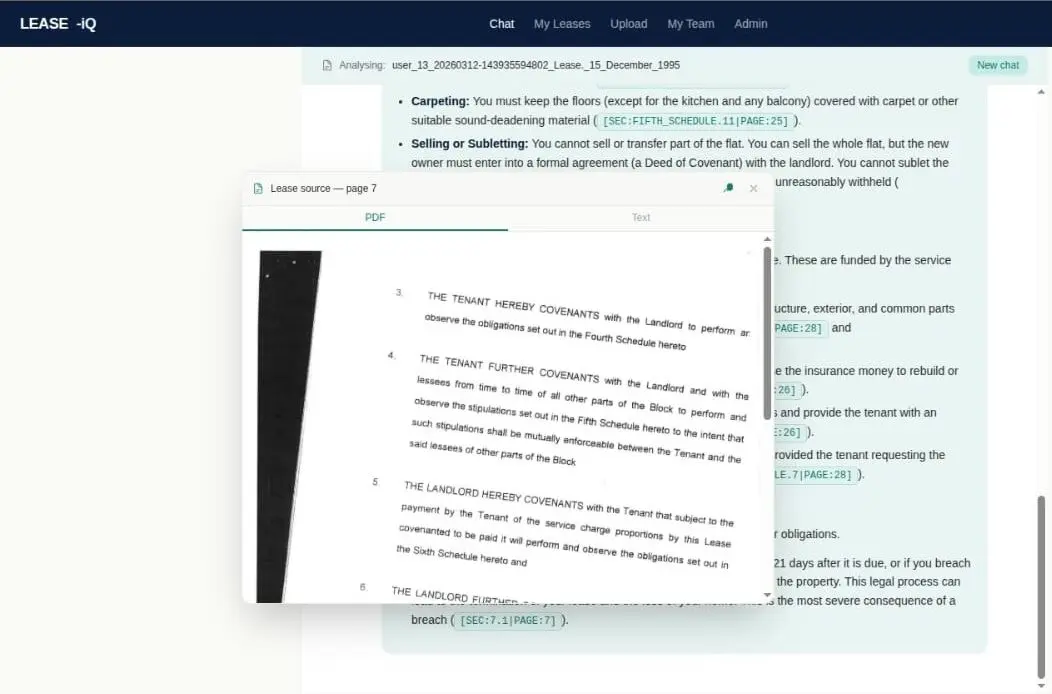
The same signed lease is easier to act on when the answer stays connected to the page behind it.

The old way tangles emails, lease PDFs, property systems and regulations between the leaseholder, adviser and one expert. The LEASE-iQ way moves a real question through the clause and law, the actual page, both sides, then a draft and outcome.
The old way and the LEASE-iQ way.
A real LEASE-iQ answer with the cited page of the signed lease open in the PDF viewer
LEASE-iQ screen. The cited lease page stays open over the answer.
Download the one-page visual

LEASE-iQ improves the first answer linked to its sources. It does not decide disputed facts or replace accountable professional judgment.

Residential and commercial leases

What LEASE-iQ helps you do.

Understand the wording, check what supports the answer and decide what would move your issue forward.

What is LEASE-iQ?

LEASE-iQ is Building Trust’s AI lease-analysis application for residential and commercial property. It helps you reason over the signed lease and relevant legislation, find the source behind an answer and identify what still needs checking. It supports leaseholders, property teams and advisers; you review the evidence before acting.

Can LEASE-iQ work with a poor scanned lease?

Yes. The Newsteer example uses a difficult commercial lease from 1963. It shows useful extraction alongside an unresolved point. A poor scan can leave wording uncertain: LEASE-iQ should say when it cannot establish an answer, and you can open the original page to personally verify the reading. Watch the Newsteer example.

Does it check the lease and legislation together?

LEASE-iQ analyses the signed lease alongside relevant legislation for the question asked. Open the cited clause, page and legislative provision, check that they support the answer and confirm why they apply to the property and issue. See the source-checking standard.

Can it help prepare a letter or a property solicitor’s brief?

After checking the answer, ask for a focused draft using the facts and sources you have confirmed. Keep missing evidence and unsent correspondence clearly labelled. Review the wording and how the recipient might read it. Complex or unresolved legal issues can be organised into a draft brief for a property solicitor to review. See the brief workflow.

How do I get started?

Prepare one question with Describe your problem. Then request access or sign in to LEASE-iQ, upload or select the correct lease and paste the question. Check the sources before asking for a follow-up draft. Watch the simple getting-started film.

For a complex issue

Turn a complex case into a brief your property lawyer can work from.

Use the same LEASE-iQ conversation to bring together your objective, the relevant wording, what happened and the questions that need legal advice. Build a detailed draft in stages, then check its facts and references before sharing it.

One request at a time. Explore the lease, check the sources, then ask for a short draft brief. Check its facts and references before sharing it.

See an illustrative property-lawyer briefing
Illustrative draft for review

Property lawyer briefing: a disputed water leak

An editorial example based on the published managing-agent workflow. It is not an actual client brief, an unedited LEASE-iQ output or legal advice. No customer documents are reproduced. Dates, parties and exact references must come from the real case.

The outcome wanted

Stop the water ingress, establish who should arrange the investigation and repairs, and understand any basis for recovering the costs. Confirm this objective with the person seeking advice.

The issue to resolve

Water ingress has been reported in a flat. Two possible explanations have been raised: a bathroom refurbishment in the flat above and a communal waste stack. The physical cause is not established in this illustration. The lease cannot establish it.

The brief should distinguish the affected leaseholder’s account, the upstairs owner’s position and the landlord’s or managing agent’s account. Do not turn an allegation or a possible explanation into an agreed fact.

The documents and relevant wording

Identify the correct lease, parties, property, date and version. Add the provisions relevant to repair, access, insurance and cost recovery, including definitions, schedules and exceptions that affect the reading.

For each material point, include the document name, clause and page, the relevant wording and any missing context. Record whether you have opened and checked the original. Exact references are intentionally absent from this illustration; they must be taken from the actual documents.

List other potentially relevant documents separately: the upstairs flat’s own lease, later variations, plans, insurance policy and investigation reports. Mark each as supplied, not supplied or requiring confirmation. Do not assume another flat has the same terms.

Chronology and correspondence

Complete from the case record; do not fill gaps with assumptions.
EventStatus in this illustrationEvidence to add
Leak reportedReported; date unknownOriginal report and any dated photographs
Investigation or inspectionNot confirmedInstruction, visit record and findings, if available
Notice or replyNot providedCopy and date; distinguish a draft from a message actually sent

What remains unresolved

  • The physical source of the leak and whether it is continuing.
  • Which documents apply to each relevant property and party.
  • What investigation, access requests or work have actually occurred.
  • Any insurance response and evidence supporting proposed costs.
  • Any deadline, urgent risk or disputed account that the adviser should know about.

Questions for the property lawyer

  1. What responsibilities arise under each relevant document, and which wording supports that reading?
  2. Who should arrange the investigation or work, and what access or notice requirements need checking?
  3. Do any exceptions, insurance provisions or later documents change the position?
  4. On what basis, if any, could investigation or repair costs be recovered? Please distinguish possible service-charge recovery from any separate claim against an individual.
  5. What further evidence or documents would change the advice?
  6. What should the client do next, and are there urgent steps or deadlines to address?

Material to accompany the brief

The relevant documents, checked source references, chronology, reports and correspondence list. Mark missing items visibly. Record the questions already explored in LEASE-iQ and the interpretations that still need professional review.

Requested outcome from the adviser: advice on the unresolved responsibilities and a practical next-step plan. The draft does not establish liability or authorise recovery of costs.

  1. Describe the issue, your role and the outcome you want. Say what is known, disputed or missing.
  2. Work through one lease question at a time and open the relevant sources. Confirm any checks you have actually made.
  3. First ask: “Summarise only the status of the correspondence. Distinguish what is known from what is unknown.” Then copy the short brief request below. Ask separately: “Check your draft against the facts I supplied. Which factual details or assumptions have you added that I have not confirmed?” Review the revision before sharing it.
Prepare the draft brief in LEASE-iQ
Open LEASE-iQ ↗

Check these points before sharing the draft
  • Your account is distinguished from established facts, disputed points and assumptions.
  • A draft is not described as sent. Missing correspondence or dates are marked unknown.
  • The correct lease and other documents are identified. Another flat’s terms are not assumed.
  • Every source reference is attached and checked, or its absence is made explicit.
  • The note asks a focused question for the solicitor. It does not decide the dispute.

Nothing is sent to the solicitor or LEASE-iQ by this page.

Ask for the next section once you have checked the last. Your lawyer reviews the draft and advises on the unresolved questions.

About an hour’s lease-summary work, reduced to about five minutes. In one live workflow reported by Adam, that included personal validation and formatting an existing Word template with Copilot. An individual example, rather than a guaranteed time for every task.

Coming soon for property teams

One question. Across selected leases.

A block with 50 leases can mean 50 sets of terms to consider before issuing one policy. Ask one question across selected leases and get lease-specific findings in one view. Make differences visible before drafting the wording people will use.

The multi-lease workflow is demonstrated in development; wider access is being confirmed. The published drainage example uses eight leases, not a tested 50-lease batch.

See the work and the finished communication

What should we work on next? Share the outcomes that matter to you and help shape Q1.

Professional boundary

Do the groundwork. Know when judgment is needed.

LEASE-iQ helps organise the documents, sources, reasoning and next question. It does not decide disputed facts, inspect a building or turn incomplete sources into certainty. Later deeds may change the answer. Deeds of variation are not yet applied automatically, so supply and check any later documents that affect the question.