
- Homeownership
- Repairs
- Legal
- Managing agent
- Resident emails
For housing associations
The policy says no. What does the lease say?
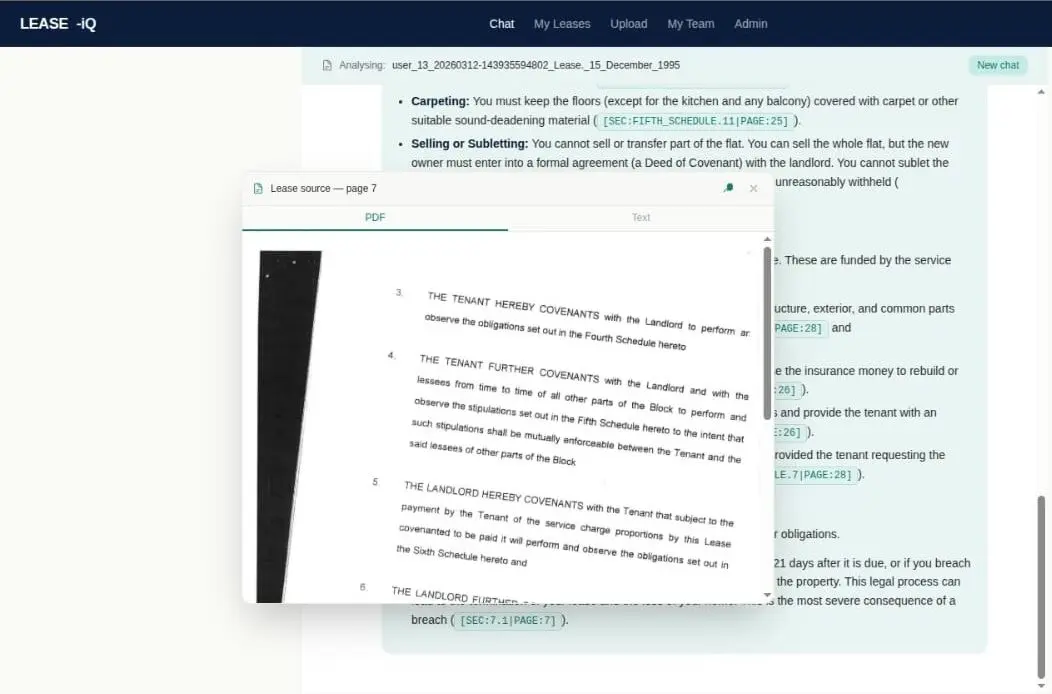
LEASE-iQ® helps homeownership, repairs, property and legal teams interpret leases consistently across a portfolio. It keeps the signed wording and current sources beside each live repair, consent or service-charge case.
The film uses Adam’s real Hafer Road lease and a clearly labelled illustrative policy. It demonstrates the checking process; the sample wording is not Eastlight’s policy.
Where the time goes
The questions that need a consistent answer across schemes, teams and leases written in different eras.
01Resale packs
Find the document, obligation and missing information holding up the answer.
Open the detail →02Repairs argumentsOpen the repairing covenant before policy and memory take over.
Open the detail →03Consent requestsCheck whether consent is required, who gives it and what conditions apply.
Open the detail →04Service-charge questionsSeparate the lease route from the demand paperwork and supporting evidence.
Open the detail →An Eastlight example · one connected issue
A repair, a policy and a resident waiting for an answer.
The colleague’s understanding of the policy appeared to differ from the lease. Work through the repair responsibility, cost recovery and allowance separately, then bring the checked findings into one response.
Ask one question at a time. These are suggested prompts based on an anonymised customer use case. Adapt the facts to your own lease.
01 Who should arrange the repair?
Read the repair promise with the definitions and exceptions.
02 Can we charge the cost back?
Check the charging words separately from the duty to repair.
03 Does the repairs allowance apply?
Check the initial repair period, dates, eligible work and any limits.
04 How does the policy compare?
Supply the actual policy passage; a colleague’s description is context to check.
05 Prepare the next response
Bring the checked findings together, then review the draft before sending.
The useful outcome
A case note you can verify and act on: who arranges the work, what supports the cost and allowance position, what remains unknown, and the next action for the resident.
Read the Eastlight case study and other complex examples →
Eastlight’s example records an investigation into a possible policy mismatch. It does not establish that the policy was wrong or that the case was resolved. Confirming several questions together will be demonstrated once that feature is live and tested.
The handoff, before and after
Give the first person a source they can show the second.
Who is responsible for this repair?
- 01Signed lease
- 02Relevant wording
- 03Evidence still needed
- 04Focused escalation
A clearer first pass
Keep the source with the case as it moves.
Difficult cases still need the right legal and professional input. A better first pass gives that person the lease, the question and the missing evidence in one place.
- 01Use the signed document
Start with the lease and the real question, not a generic policy answer.
- 02Separate the layers
Keep the lease, current law and missing evidence distinct.
- 03Keep the source open
Give the next person the clause, page and point that still needs judgment.
The result
A checked position that repairs, homeownership and finance can use.
Bring the repair duty, charging position and allowance conditions into one case note. Keep the source beside each finding, identify what is still missing, and give the resident a clear next step.
Use it on live work
Use the case that keeps coming back.
Choose one resale, repair, consent or service-charge question. Check whether the first person can find the clause and show the next person exactly what still needs judgment.
See how LEASE-iQ worksIndependent help
LEASE offers free, independent leasehold guidance.
building trust is not the only route. The Leasehold Advisory Service publishes guidance and offers appointments for leaseholders and park-home owners.
Visit LEASEOne team. One month. No cost.
Use up to 100 leases and ask the questions already arriving.
This is not a product tour or a separate workflow. After a 30-minute setup, the team uses LEASE-iQ for live work throughout the month. Add up to 100 leases and ask as many genuine work questions as the team needs.
Request our free team monthNo card. No automatic conversion. The team agrees what to measure before it starts.Download and pass it on
A LEASE-iQ briefing for housing-association teams
Share the team workflow, source standard and manual one-month access route.
Download the PDF