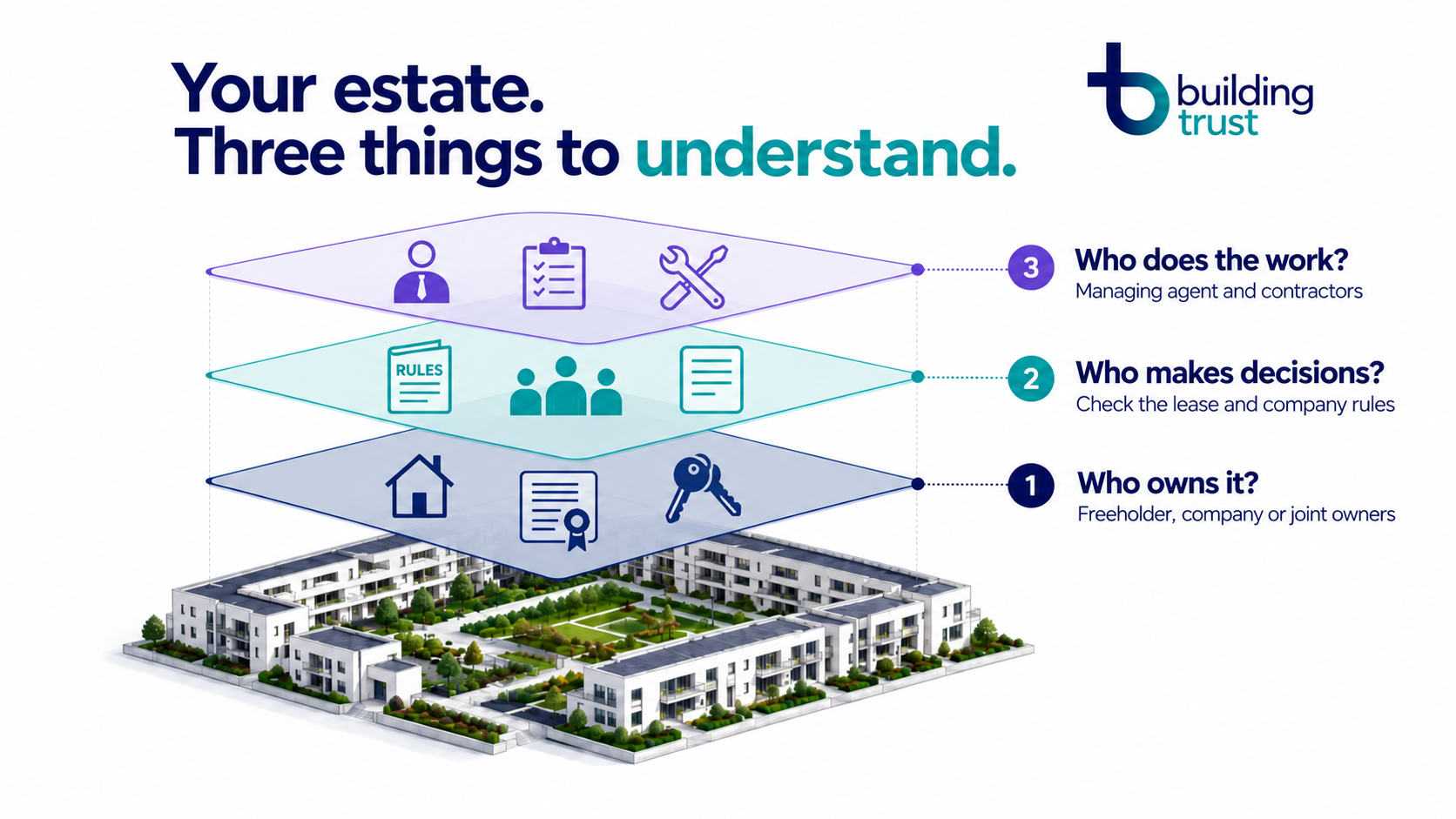
Owning a flat, owning the freehold and running the building are three different things. Find out who makes the decisions, who appoints the managing agent and what you can have a say in.
The same estate can have several buildings, companies and shared services. Check which part each company manages. Enlarge illustration ↗
START WITH THREE QUESTIONS
Same estate. Three different roles.
01 · OWNERSHIP
Who owns it?
The freeholder owns the land and building. That might be an outside landlord, a company owned by residents or residents holding it together. In commonhold, you own your unit and the association owns the shared parts.
Check: the current property titles and, if a company owns the freehold, your interest in that company.
Why does this matter?
Being a member of a management company does not, by itself, mean you own part of the freehold. Ownership and management can sit with different people.
02 · DECISIONS
Who makes decisions?
The lease, company rules, an RTM takeover or a tribunal order can give different people different jobs. Directors usually run a company; members vote on the matters reserved to them.
Check: which organisation has the job, whether you are a member, your voting rights and any developer control.
Why does this matter?
You might have a say through the company as well as rights under your lease. But a vote does not normally let you personally approve every invoice or instruct the agent.
03 · DELIVERY
Who does the work?
A managing agent may organise repairs, accounts and contractors for the organisation that appointed it. Contractors carry out particular jobs. Sometimes the landlord or residents’ company manages directly.
Check: who appointed the agent, what it is paid to do and who can give it instructions.
Why does this matter?
A complaint about the agent’s service is different from a dispute over whether you owe a charge. You may need to raise a decision with the board as well as report the problem to the agent.
01 / EXPLORE
Same building. Different control.
Choose an arrangement to see who owns the property, who runs it and where you fit in.
Typical arrangement
In plain English
↗
How you can have a say
What you can influence
What you cannot assume
Documents to check
More than one description can apply. For example, the residents’ management company might also own the freehold. Your block and the wider estate might have different companies looking after them.
THE DISTINCTION THAT MATTERS
RMC or RTM? How did the company get the job?
RMC: the lease gives the company its job. Often set up when the development is built. The lease says what it must do. Residents may be able to vote on how the company is run, but the developer may still control it until an agreed handover.
RTM: leaseholders use a legal process to take over. Eligible leaseholders form a right-to-manage company and complete the takeover process. They do not have to prove the existing manager did a bad job. The freeholder still owns the freehold.
Both can appoint an agent. Neither label, by itself, means you own the freehold. Read LEASE’s explanation ↗
02 / FIND YOUR ARRANGEMENT
What do your documents say?
Five short questions. No specialist knowledge needed. “Not sure” is a useful answer. Nothing is uploaded or submitted.
DOCUMENT CHECK
Start with evidence. Build your picture.
A company name or a sales brochure is a clue. The lease, title and membership records tell you more.
This identifies a possible arrangement, not a legal determination or an RTM eligibility test.
FROM UNDERSTANDING TO ACTION
What problem are you trying to solve?
The lease is one part of the picture. Company rights, complaints, collective action and legal remedies can offer different routes. Choose your problem to see where to start.
These are possible starting points, not a finding that you qualify or a recommendation to start proceedings. Check deadlines, costs and the right organisation to approach. Do not stop paying sums that are due as a way of forcing a response.
A safety risk needs prompt reporting through the appropriate emergency or building-safety route; do not wait for a company meeting or complaints process.
03 / COMPARE AT A GLANCE
Ownership is not the same as control.
Arrangement
Freehold ownership
Why it can manage
Your say
Landlord-managed
External owner
Lease obligations
Leaseholder rights; no automatic company vote
RMC
External or resident-owned
Lease / contractual arrangements
Member votes under the articles; check developer rights
RTM
Ownership unchanged
Statutory takeover of management functions
Members govern the RTM company
Share of freehold
Residents directly or through a company
Leases plus company / joint-owner arrangements
Collective ownership and governance rights
Commonhold
Your unit; association owns common parts
Commonhold law, CCS and articles
Unit-owner membership and votes
Tribunal-appointed manager
Ownership unchanged
Tribunal order
Raise issues; the manager answers to the tribunal
WORDS YOU MAY SEE IN YOUR DOCUMENTS
What does that mean?
Freeholder and leaseholder
The freeholder owns the freehold title to the land and building. A leaseholder owns the right to their flat for the years left on the lease. The lease sets out responsibilities and payments.
Member, shareholder and director
A member belongs to the company and has the rights set out in its rules. In a company with shares, shareholders are members. A company limited by guarantee has members without shares. Directors sit on the board and run the company. Being a member does not automatically make you a director.
Articles and register of members
The articles are the company’s rulebook: for example, who can vote and how directors are appointed. The register of members is the company’s own official membership list. Ask for your entry; do not assume buying the flat completed every membership step.
Managing agent and management company
The management company has responsibilities for the building. The managing agent is a business hired to carry out work such as arranging repairs, collecting charges and keeping accounts. Their similar names can hide the fact that they have different roles.
Headlease or intermediate landlord
There may be another landlord between you and the freeholder. That landlord holds a lease over a larger part of the property and grants leases to individual flats. You may need to trace more than one link in the chain.
Statutory rights and tribunal orders
Statutory rights are rights given by law. A tribunal is a specialist legal decision-making body. If it appoints a manager, its written order says what that manager can do and for how long.
04 / TURN CLUES INTO CONFIRMATION
Follow the paper trail.
You may need more than one document—and more than one company name.
01
Who owns the land?
Check the current freehold title at HM Land Registry. If a company owns it, match its exact name and number. Your flat’s leasehold title is a different record.
Read the lease parties, repair covenants and service-charge schedules. Look for separate block, estate, headlease or heat-network arrangements. Check an RTM acquisition or tribunal order if relevant.
03
Are you a member?
Ask the company secretary for your register entry, admission date and admission documents. Read the articles for voting and director-appointment rights. A Companies House search is not a complete current member list.
Ask who signed the management agreement, who approves the budget and how members can raise matters with the board. Check the appointment and termination terms before assuming you can replace the agent.
Shares, membership and a £1 guarantee: what changes?
In a company with shares, shareholders are members. A company limited by guarantee has members but no shares. Voting depends on the articles, not on the word “shareholder”. A winding-up guarantee is different from ordinary service charges or any separately authorised member contribution; it is not a cap on every payment you may owe.
Does a say in management mean I can approve every bill?
No. Directors usually take day-to-day company decisions. Members exercise the voting rights given by the articles and company law. Service-charge spending remains constrained by the lease and applicable law; company money and service-charge funds have different purposes. A company demand still needs a valid basis.
What about shared ownership, council or housing-association flats?
Shared ownership describes how you hold your home and pay for the unowned equity. It is not “share of freehold”. Your immediate landlord may sit beneath a headlease and a separate freeholder or management company. Trace the full chain. Membership and statutory routes depend on the particular lease, provider and applicable eligibility rules.
What if the building has a residents’ association?
A residents’ association can organise a collective voice. Recognition may give additional statutory rights, but an association is not automatically an RMC or RTM company and does not automatically appoint the managing agent.
England and Wales: what should I check?
The broad structures exist in both jurisdictions. Rules, eligibility, commencement dates and tribunal procedures can differ. In England, relevant property disputes generally go to the First-tier Tribunal (Property Chamber); in Wales, to the Leasehold Valuation Tribunal within Residential Property Tribunal Wales. Check current local guidance before taking a formal step. Proposed reforms are not treated as rights already in force in this guide.
A USEFUL FIRST STEP
Ask for the structure. Then ask about your rights.
Use this request with your managing agent or company secretary.
Please confirm the current freeholder, any intermediate landlord, and the company responsible for managing my block and estate. Please explain the basis of its management powers, whether I am a member, and my voting and director-appointment rights. Please provide my register entry, the current articles and any relevant handover, RTM or management-order documents, and identify who appoints and instructs the managing agent.
General guidance for flat owners in England and Wales. Check your documents before relying on a particular right. Reviewed 28 October 2026.
The illustrations show common patterns. Mixed-use estates, headleases, developer control and management orders may change the picture. This tool does not determine whether a charge is payable or whether you qualify for RTM, enfranchisement or a tribunal remedy.
Use the words you would use with a neighbour. I will suggest the closest page I can match.
This guide only matches your words to pages on this website. It does not read your lease or give legal advice. Do not paste names, addresses, lease wording or payment details.