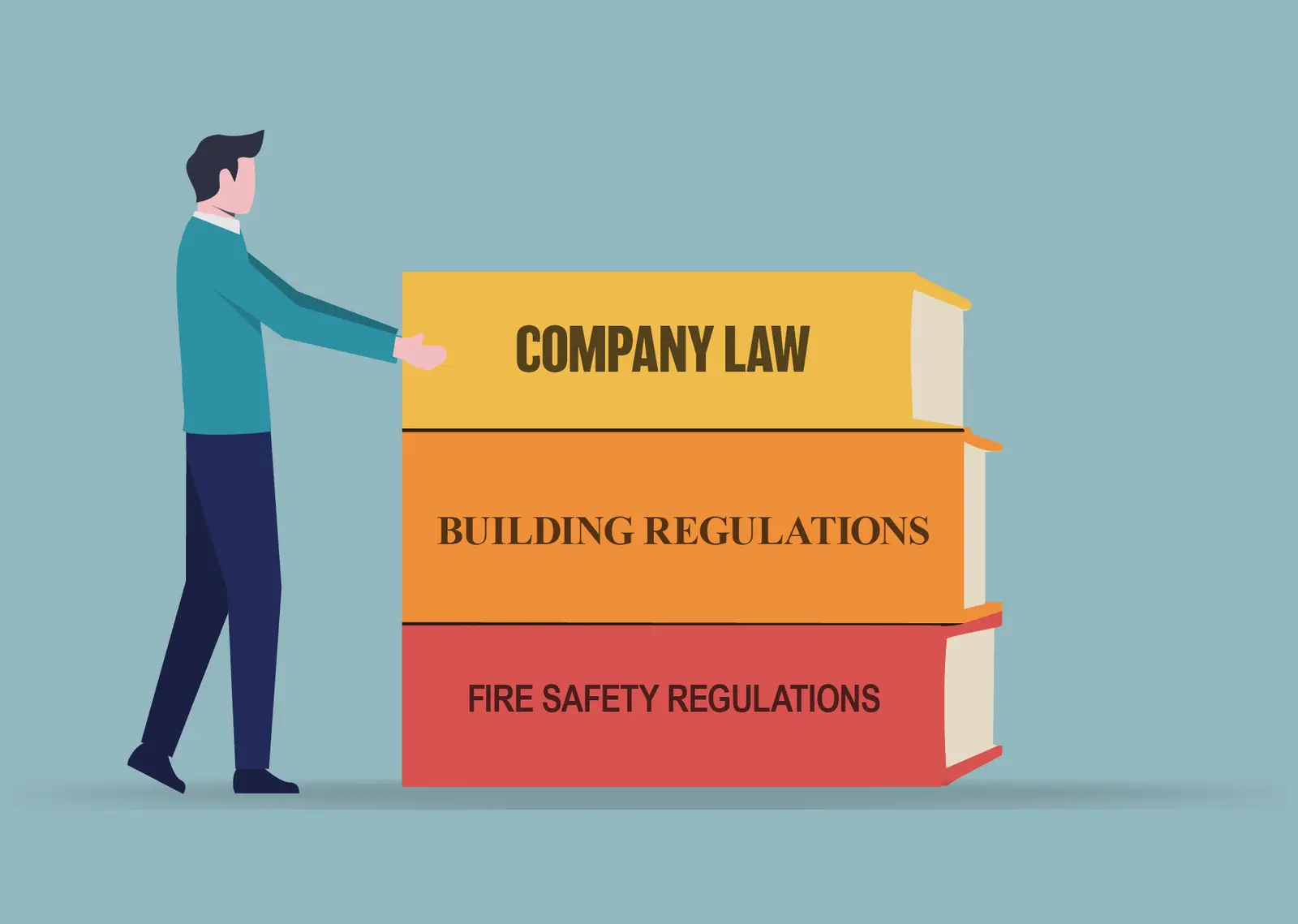
Most directors of self-managed buildings don't know what they're personally responsible for. If something goes wrong, ignorance isn't a defence.
Information only. Not legal advice. Always take professional advice before acting.
You carry personal liability for building compliance. These aren't optional - they're statutory requirements with penalties ranging from fines to criminal prosecution.
Annual review required under the Regulatory Reform (Fire Safety) Order 2005Fire Safety Order 2005. The responsible person must ensure a suitable and sufficient fire risk assessment is maintained and reviewed regularly.. Failure to maintain one is a criminal offence. The responsible person can face unlimited fines or up to two years' imprisonmentGOV.UK enforcement guidance. Unlimited fines in magistrates' court. Up to two years' imprisonment in Crown Court for the most serious offences..
Adequate buildings insurance must be maintained at all times. Directors are personally liable for gaps in cover. If the building is underinsured and a claim arises, leaseholders can hold the directors responsible for the shortfall.
Must comply with Section 21 of the Landlord and Tenant Act 1985LTA 1985, s.21. Leaseholders can request a written summary of service charge costs. The landlord must provide it within one month of the request, or six months after the end of the accounting period (whichever is later).. Accounts must be certified, sent to leaseholders within six months of the accounting year end, and accompanied by a summary of rights and obligations.
Annual confirmation statementCompanies House guidance. Every company must file a confirmation statement at least once every 12 months. Late filing is a criminal offence. RTM and SoF companies are subject to the same requirements as any limited company., accounts filing, and director change notifications are mandatory. Late filing incurs automatic penaltiesCompanies House late filing penalties. Penalties range from £150 (up to 1 month late) to £1,500 (over 6 months late) for private companies. These double if accounts are late two years running., and persistent non-compliance can lead to the company being struck off and directors personally prosecuted.
Manage these yourself. Or let BLOCK-iQ track them for you.
Fire risk assessments, insurance renewals, Companies House filings, ICO registrationICO Data Protection Register. Most organisations that process personal data must register with the Information Commissioner's Office. Annual fee for small organisations is £40. Failure to register is a criminal offence., Section 20 consultationsLTA 1985, s.20. For qualifying works over £250 per leaseholder or qualifying long-term agreements over £100 per leaseholder per year, a three-stage consultation process is mandatory. Skip it and recovery is capped at £250., health and safety inspections. Each has its own deadline, its own process, and its own penalty for missing it.
If challenged at tribunal, you need to prove you acted. That means documented decisions, dated records, signed-off risk assessments, and properly filed accounts - not just emails in someone's inbox.
Leaseholders have legal rights to request account summaries, inspect receipts, and challenge charges. You must respond within the statutory timeframeLTA 1985, s.21 and s.22. For a written summary of costs (s.21), the landlord has one month or six months after the accounting year end, whichever is later. For inspection of supporting documents (s.22), facilities must be provided within 21 days of the request. Different obligations have different deadlines. or face potential tribunal action.
For qualifying works over £250 per leaseholder or qualifying long-term agreements over £100 per year, you must follow a strict three-stage consultation process. Skip any stage and you can only recover £250.
The Leasehold and Freehold Reform Act 2024LFRA 2024. Strengthens leaseholder transparency rights, reforms service charge demands, and introduces new accountancy requirements. Provisions are being implemented in phases through 2025 and 2026., Building Safety Act 2022Building Safety Act 2022. Created the Building Safety Regulator and introduced a new safety regime. The most stringent requirements (safety cases, mandatory occurrence reporting) apply primarily to higher-risk buildings (18m+ or 7+ storeys), but the Act also expanded duties for all residential buildings., and Fire Safety Act 2021Fire Safety Act 2021. Clarified that the Fire Safety Order applies to the structure, external walls, and flat entrance doors of multi-occupied residential buildings. Removed ambiguity that previously left common parts under-regulated. have all changed director obligations. New provisions are still being implemented in phases through 2025 and 2026.
⚠️ Important: These obligations apply whether you have a managing agent or not. If you've delegated management, you're still personally liable as a director if things aren't done.
Upload your lease. Copy this prompt:
The free LEASE-iQ analysis showed you what the lease requires of directors. Now you need to operationalise it. Here's how to communicate with leaseholders, handle pushback, and get a formal obligations summary drafted.
The free analysis identified your obligations. Now tell LEASE-iQ what works you're planning and it will generate the formal consultation notice. Get it wrong and your recovery is capped at £250 per leaseholder. Get it right and you're protected.
Based on your lease analysis, LEASE-iQ will generate:
The Leasehold Advisory Service (LEASE) provides free, independent advice to directors of RTM and freehold companies. If you're unsure about your obligations or how to handle a leaseholder dispute, they can help.
Contact LEASE (free) →The penalties are real. The enforcement is increasing. And most volunteer directors have no formal training.
The Building Safety Act 2022 and Leasehold and Freehold Reform Act 2024 have significantly expanded director obligations, including new requirements for building safety casesBuilding Safety Regulator guidance. Building safety cases are required for higher-risk buildings (18m+ or 7+ storeys). They must demonstrate that fire spread and structural risks are being managed. Most SoF and RTM blocks fall below this threshold, but the Act expanded general duties for all residential buildings., mandatory occurrence reporting, and enhanced leaseholder transparency rights.
If you're a leaseholder, understanding what directors are required to do helps you hold them accountable - and know when to escalate.
Directors must provide certified accounts within six months of the year end. You have the right to request a summary and inspect supporting documentsLTA 1985, s.22. After receiving a summary, leaseholders can require the landlord to make facilities available for inspecting the accounts, receipts, and other documents. The landlord must make these available within 21 days of the request..
Section 20LTA 1985, s.20. Requires a three-stage consultation for qualifying works (over £250 per leaseholder) or qualifying long-term agreements (over £100 per leaseholder per year). The process includes a notice of intention, obtaining estimates, and a notice of proposals. requires directors to consult you before committing to qualifying works or long-term agreements. Without proper consultation, recovery is capped at £250 per leaseholder.
Your building must have a suitable and sufficient fire risk assessment, reviewed regularly. You can ask to see it - and if it doesn't exist, that's a criminal offence by the responsible person.
If directors aren't meeting their obligations, you can apply to the First-tier Tribunal (Property Chamber)GOV.UK Tribunal guidance. The FTT determines disputes about service charges, management failures, and lease terms. Applications can be made by individual leaseholders or groups. No legal representation is required.. LEASE-iQ can help you check what your lease actually requires before taking action.
LEASE-iQ helps leaseholders understand their rights by reading the actual lease - not guessing from generic legal principles.
See how LEASE-iQ works →Add your building. BLOCK-iQ maps your 21 statutory obligations, tracks deadlines, and builds an audit trail - so you can prove you acted when it matters.
See how it works →